

The Best 3D Product Configurators for Ecommerce in 2026
A 3D product configurator should help shoppers understand and buy a product, not make them wait for the product page to become usable.
We compared six strong options for 2026 across visual experience, configuration depth, ecommerce integration, checkout, runtime performance, pricing, production workflows, and one factor that most comparisons overlook: how quickly the visitor gets a useful shopping surface.
Updated August 2026
Best 3D product configurators for ecommerce: quick picks
For ecommerce specifically, Presenter3D is our best overall pick because it can separate the shopping experience from the 3D loading lifecycle. A lightweight product surface can become useful first, while 3D loads only when and how the page needs it. Commerce can remain in an existing store, move into Presenter3D Commerce engine, or use a mixture of both.
Threekit is the strongest fit for large enterprise catalogs and sophisticated sales workflows. Its current platform combines visual configuration, AI-guided selling, real-time pricing, headless checkout, order processing and manufacturing-related outputs.
Zakeke is the easiest recommendation for merchants that want a self-service product configurator with broad ecommerce integrations and transparent pricing. Its current platform includes rule-based 3D configuration and Visual CPQ rather than being limited to simple personalization.
Expivi is particularly strong where ecommerce configuration connects deeply to CPQ, ERP and production processes. It supports both existing ecommerce platforms and an Expivi-hosted webshop with its own cart or quote checkout.
Salsita is our strongest choice for made-to-order manufacturers that need the configuration to continue directly into CAD, BOM and production outputs.
Cylindo remains especially compelling for furniture brands where photorealistic visualization and modular product design are more important than general-purpose CPQ.
3D ecommerce configurators at a glance
| Platform | Best for | Configuration | Ecommerce / checkout | Delivery model | Pricing |
|---|---|---|---|---|---|
| Presenter3D | Best overall ecommerce product experience | Parametric + rule-based | External, native or mixed commerce | Studio-authored | Production quoted; recurring tools published |
| Threekit | Enterprise catalogs and sales workflows | Advanced rule-based / visual configuration | Ecommerce integrations, headless checkout and order processing | Platform + implementation | Custom quote |
| Zakeke | Self-service ecommerce | Rule-based 3D + Visual CPQ | Deep existing-store integration | Self-service SaaS | Published from $69.90/mo on Shopify |
| Expivi | CPQ + ERP-connected ecommerce | Advanced rule-based and modular | Existing platforms + Expivi-hosted webshop/checkout | Platform + integration | Custom license |
| Salsita | Made-to-order manufacturing | Parametric + rule-based | Existing ecommerce integration | Custom implementation | Scope-based |
| Cylindo | Furniture visualization and modular design | Modular and preset-driven | Existing ecommerce stack | Platform + services | Custom quote |
What we looked at
Most “best configurator” comparisons focus on how many product combinations a system can generate. That matters, but ecommerce has a broader job.
| Criterion | What we mean |
|---|---|
| Visual experience | What the shopper actually sees and how much control the experience provides |
| Configuration depth | Simple choices, rule-based combinations, modular assembly or continuous parametric controls |
| First shoppable surface | How quickly a visitor can see a useful product surface, choose options or start buying |
| 3D runtime performance | How the experience manages loading, rendering and device limitations |
| UI flexibility | Whether controls must live inside the configurator or can integrate with the surrounding page |
| Pricing and stock | Where live business data originates and how it reaches the configurator |
| Checkout and commerce | Whether the platform integrates an existing store, supplies checkout itself, or supports both |
| Business integrations | Ecommerce, ERP, PIM, CRM and custom APIs |
| After configuration | Orders, invoices, production outputs, BOM, CAD and downstream workflows |
| Delivery model | Self-service platform, enterprise implementation or studio-built experience |
| Pricing | Published pricing versus custom quotation |
We did not attempt to rank raw frame rates or benchmark identical 3D scenes across six different engines. That would require controlled testing rather than marketing pages.
The ecommerce metric most 3D configurator comparisons miss
Time to first shoppable surface
A conventional ecommerce product page can show an image, price, availability, options and an Add to Cart button almost immediately.
That creates an awkward question for 3D commerce:
If a 3D configurator needs several seconds before the visitor can do anything useful, has the shopping experience actually become more modern?
The issue is not that a detailed 3D scene takes time to download. It often will. The issue is whether the rest of the product experience has to wait for it.
Shopify itself advises merchants to evaluate the performance cost of storefront features and explicitly asks which functionality must exist at the top of the page and which functionality can load later. Its performance guidance notes that apps, scripts, images, videos and other third-party features can affect loading speed and responsiveness.
Google likewise describes deferring non-critical content through lazy loading as a standard performance and UX technique, provided important content remains crawlable.
That is why this guide separates two questions:
How quickly does the 3D viewer load? and how quickly can the shopper start shopping? They are not the same thing.
Presenter3D
Best overall for an end-to-end ecommerce product experience
Presenter3D approaches ecommerce differently from a conventional configurator.
Instead of treating the 3D viewer as the product page, it treats 3D as one layer of the product experience.
A product can begin as a static image or gallery, progress into a cinematic real-time 3D presentation, and become fully interactive when the visitor engages. None of those stages is mandatory, including 3D itself.
That difference becomes particularly important for ecommerce.
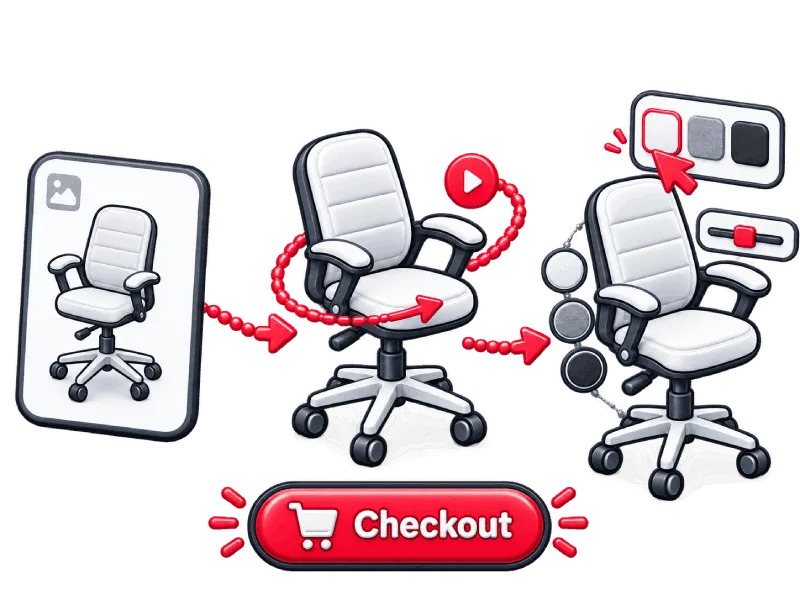
The shopping surface does not have to wait for 3D
Presenter3D Hybrid mode can expose a lightweight product interface first while the full 3D scene loads in the background.
The visitor can already choose options, see price and availability, check stock and start checkout from that flat surface. When the viewer becomes ready, the same selected configuration is applied to the 3D experience.
Crucially, this does not require Presenter3D Commerce engine.
The business data and transaction flow can come from an existing ecommerce platform or other third-party business system. Presenter3D can integrate the external controls, product state and commerce data with the viewer so the existing system remains authoritative.
The alternative is Presenter3D's own Commerce engine, or a mixed setup where each system owns the part of commerce it is best suited to handle.
The viewer does not have to compete with the rest of the website
Presenter3D also gives the page control over when the 3D runtime begins loading.
That can matter considerably on real ecommerce sites that already contain hero animation, recommendation systems, analytics, consent tools, product galleries, personalization scripts and other JavaScript.
The viewer can therefore be deferred or lazy-loaded instead of competing with every other page feature immediately after navigation.
Performance continues after loading starts
Presenter3D also uses a performance-oriented rendering architecture.
The viewer can begin with very low-resolution textures and progressively replace them with higher-resolution versions as they arrive. Texture resolution is adapted to the device, and textures belonging to invisible objects can be released from GPU memory and regenerated when those objects become visible again.
Lighting is designed around prebaked lightmaps wherever practical instead of relying on expensive fully dynamic lighting. Dynamic-looking lighting states can still be achieved using techniques such as DualRGBM without requiring the same runtime cost as an equivalent fully dynamic scene.
The point is not simply to make a benchmark number look good. It is to make richer product experiences practical across a broader range of real devices.
Configuration is not limited to preset variants
Presenter3D supports both rule-based discrete configuration and continuous parametric controls.
A dimension, position or other continuous value can change directly rather than requiring every possible value to exist as a preset option. Prices, stock and delivery information can update alongside the configuration when supplied by the connected commerce source.
The interface is equally flexible. A project can use Presenter3D's native controls, a completely external website interface, or both simultaneously with bidirectional synchronization.
Keep your existing ecommerce stack
For an established ecommerce business, Presenter3D does not require migrating commerce into another platform.
The free Sync API can keep the existing store authoritative for pricing, stock, availability and checkout. Shopify and WooCommerce have ready-made connectors, while other REST/API-capable systems can be connected during integration.
This makes Presenter3D useful as a product-experience layer even when the merchant has no interest whatsoever in replacing its ecommerce backend.
Or avoid assembling an ecommerce stack in the first place
The opposite problem appears frequently for a startup or smaller business launching a new product.
Creating an online store can mean selecting and connecting several different pieces: storefront, payment gateway, inventory, regional pricing, tax logic, shipping, transactional email, invoicing and order management. Exactly how fragmented that becomes depends on the ecommerce platform and the business.
Presenter3D Commerce engine is the optional alternative.
A business can connect its payment gateway and let Presenter3D own the transactional layer, including pricing, stock, checkout, orders, invoices, returns, tax logic and payment/shipping routing. Shipping or specialist tax providers can still be connected where the business requires them.
Commerce engine can also power ordinary flat product pages. A 3D configurator is not required.
This makes the same platform useful at two very different stages: an established merchant can keep everything it already has, while a new business can avoid building much of that stack separately.
Where Presenter3D is less suitable
Presenter3D is studio-authored rather than a pure DIY configurator builder. A genuinely new base product requires production work from the studio, although variation-level changes can later be managed through the dashboard.
It also does not currently generate manufacturing outputs such as CAD files, BOMs or cut lists, and it does not provide a conversational AI configuration assistant.
For manufacturers where configuration-to-production automation is the central requirement, Salsita or Expivi may therefore be a stronger fit.
Pricing: production is scoped per project. Presenter3D-branded hosting is free with unlimited public views. Experience Management is €7 per experience/month billed yearly, Analytics PLUS adds €3, and Commerce engine is €49 per brand/month billed yearly.
Sources: Presenter3D homepage, live office-chair example, Presenter3D vs Threekit, Presenter3D vs Salsita.
Verdict
The strongest overall option here when the ecommerce experience itself matters as much as the configuration engine behind it.
Threekit
Best for enterprise catalogs and sophisticated sales workflows
Threekit remains one of the broadest enterprise products in this category.
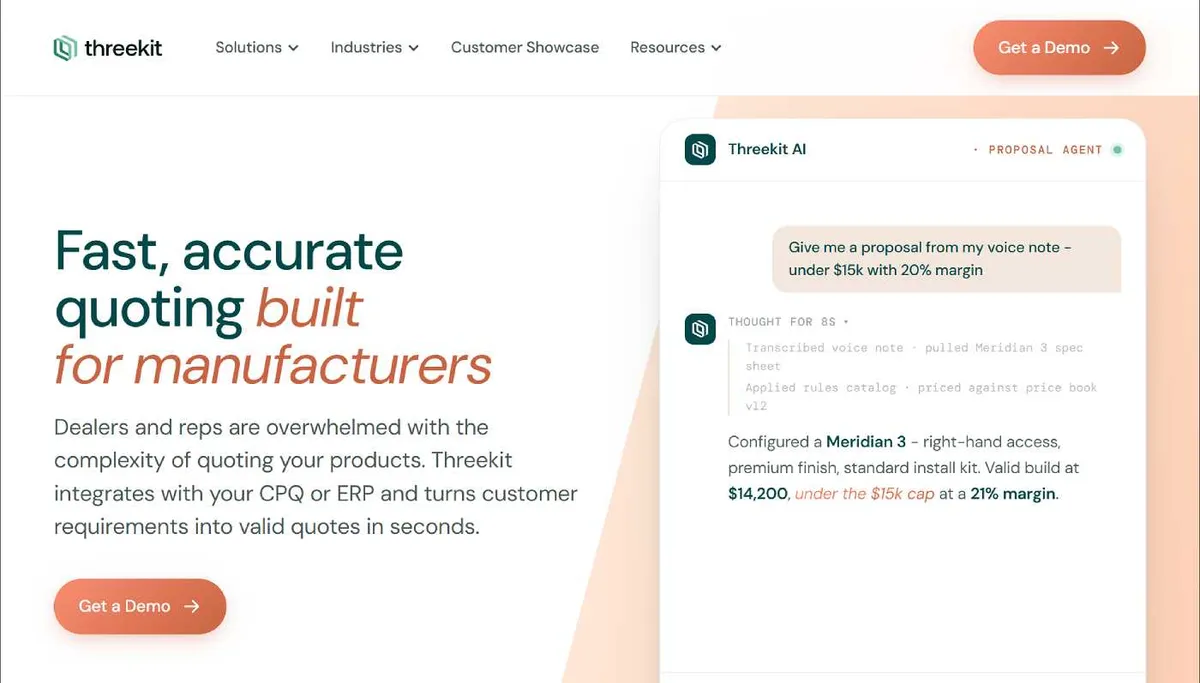
Its current Product Configurator combines product data, rules, options and pricing with dynamic visual configuration. Buyers can modify materials, features and dimensions, while Threekit's newer AI layer adds guided selling and recommendations.
The platform extends significantly beyond visualization. Threekit currently documents real-time quotation and pricing, order processing from cart to fulfillment, manufacturing instructions and Bills of Materials. It also promotes a headless checkout solution that can integrate into a merchant's front or back end.
Its ecommerce integrations include major commerce and business systems, and the platform is designed to serve online shoppers as well as sales representatives, dealers and distributors.
That makes Threekit particularly compelling for large organizations that need one configuration platform to support many channels and complex catalogs.
From an ecommerce-performance perspective, Threekit describes its configurators as fast, but I did not find public documentation in the materials reviewed describing an equivalent flat shoppable surface first, 3D progressively afterward architecture. That should not be interpreted as a claim that Threekit cannot implement such a flow, only that an equivalent mechanism was not confirmed from the public material reviewed for this guide.
Pricing is custom and depends on the use case.
Sources: Threekit Product Configurator, ecommerce integrations, pricing.
Verdict
A stronger choice than Presenter3D when large-scale enterprise configuration, AI-guided selling and multi-channel sales operations are the primary problem.
Zakeke
Best for self-service ecommerce configuration
Zakeke has evolved well beyond the simple product-personalization tool it is sometimes described as.
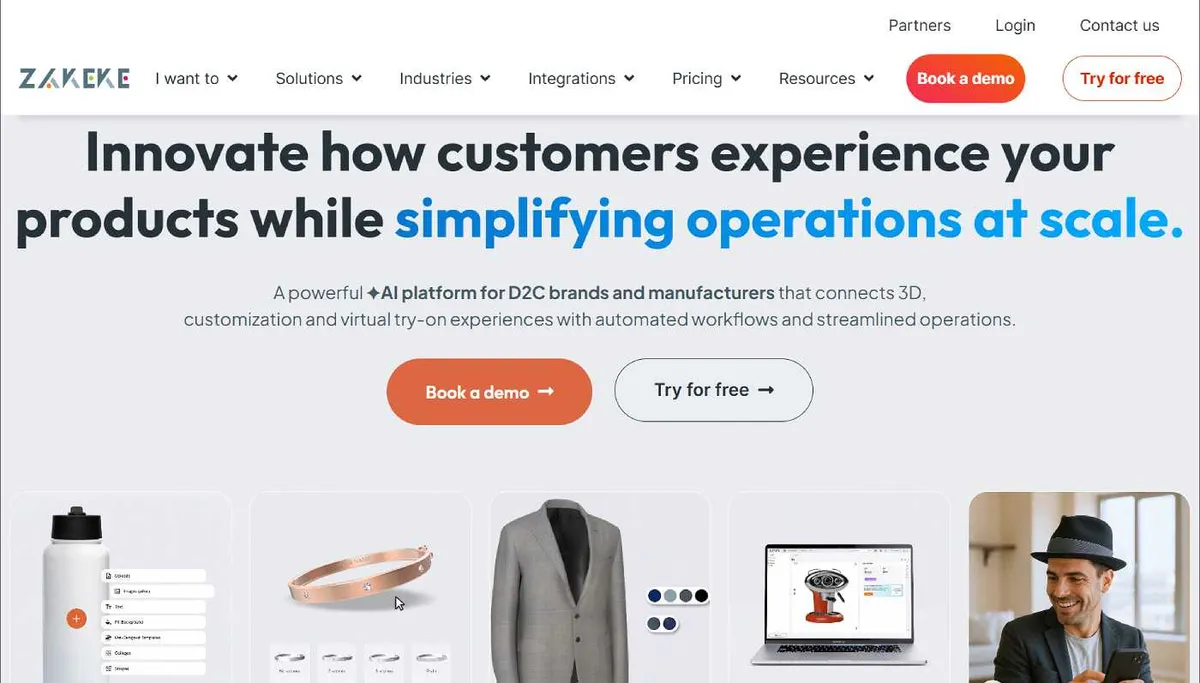
Its current platform includes a rule-based 3D Product Configurator, components and variants, Visual CPQ, 2D customization, AR, virtual try-on and a 3D asset-management layer.
Its biggest ecommerce advantage is accessibility.
Zakeke supports a broad range of commerce platforms, including Shopify, WooCommerce, Wix, PrestaShop, Adobe Commerce, BigCommerce and others. Its documentation also exposes APIs for custom integrations.
The technical API flow is closely tied to the host ecommerce system. The store can supply pricing and availability to the configurator, and when configuration is complete Zakeke passes the resulting configuration back into the ecommerce cart.
That is a strong model when the merchant already has a store and primarily wants to add configuration.
Zakeke is also the most transparent on pricing among the major options here. Its current Shopify listing starts at $69.90/month, with Grow at $129.90 and Scale at $299.90. The 3D Configurator and AR/DAM viewer are included from Starter. Shopify plans also carry a transaction percentage by tier, with a $0.02 minimum.
For design-to-print and personalization workflows, Zakeke can also generate production-ready files such as PDF, PNG, SVG and DXF.
I did not confirm the same Hybrid-style first-shoppable-surface architecture documented by Presenter3D in the public materials reviewed, so we would not rank Zakeke above Presenter3D on that particular criterion without controlled implementation testing.
Sources: Zakeke homepage, Visual Product Configurator, configurator UI API, Shopify App Store listing.
Verdict
The easiest recommendation for merchants that want to configure products inside an existing ecommerce stack without commissioning a fully custom experience.
Expivi
Best for ecommerce that connects deeply to CPQ and ERP
Expivi sits between ecommerce configuration and manufacturing-oriented CPQ.
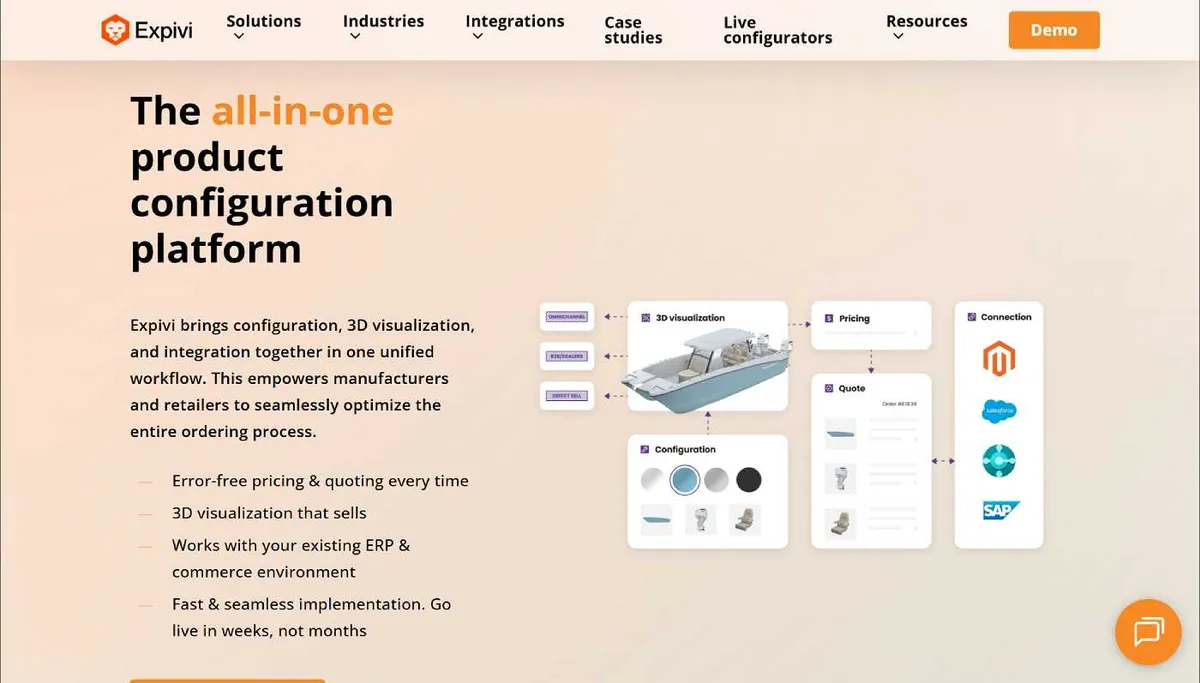
Its current platform combines real-time 3D, Visual CPQ, dynamic pricing and production automation. Its newer modular configurator supports assembly, snapping, compatibility rules and other logic for complex configurable products.
Expivi also has strong integration coverage. It documents Shopify, Magento, WooCommerce, SAP Commerce Cloud, Salesforce, Sana, Shopware and custom API integrations, with pricing, product, configuration and order data able to synchronize between systems.
Importantly, Expivi should not be characterized as external-commerce-only.
Its documentation states that an Expivi company subdomain can generate its own webshop with shopping-cart or quote checkout. At the same time, its Shopify, Magento, WooCommerce and Sana integrations can use the merchant's existing commerce workflow.
That flexibility is useful when a manufacturer needs both direct selling and deeper backend integration.
Expivi also goes further toward production than Presenter3D, with documented BOM and production/design-to-print workflows.
Public pricing is scope-dependent rather than presented as a simple self-service ladder.
As with Threekit, I did not find public documentation describing an equivalent Presenter3D-style first-shoppable-surface loading architecture. That is a documentation finding, not an assertion that Expivi cannot implement one.
Sources: Expivi homepage, 3D Configurator, account/webshop documentation.
Verdict
A particularly strong choice when product configuration, pricing, ERP data and production workflow matter more than highly authored presentation.
Salsita
Best for configuration-to-production automation
Salsita is the strongest manufacturing-focused option in this group.
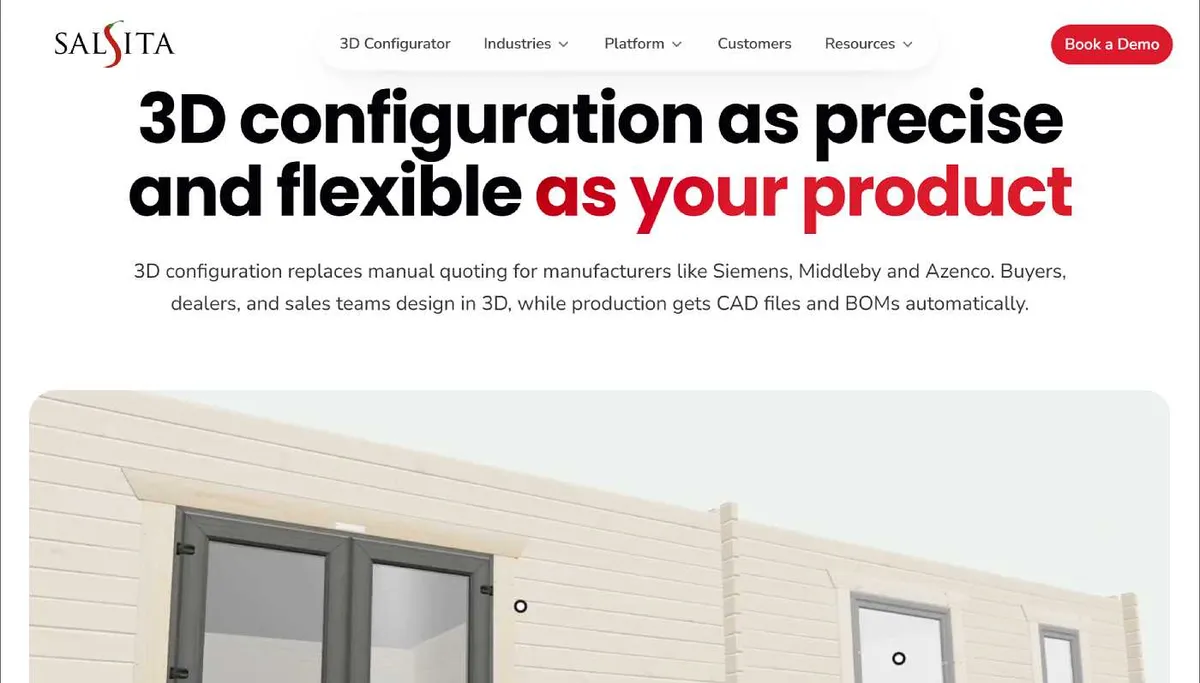
Its current configurator supports visual CPQ, modular and parametric products, live rules and pricing, and integrations with ERP, CRM and ecommerce systems.
Where Salsita differentiates itself is what happens after the buyer completes the configuration.
The platform can automatically produce CAD files, BOMs, cut lists and other manufacturing outputs, allowing a validated configuration to move much closer to production without being manually recreated by engineering teams.
Salsita also offers conversational AI that can modify configurations through natural language and voice.
For ecommerce, its public documentation describes passing configured products into the merchant's existing ecommerce flow, preserving the standard cart, checkout, payment, emails and order-management functionality.
I did not confirm a separately documented Salsita-owned commerce backend comparable in breadth to Presenter3D Commerce engine in the public materials reviewed.
The tradeoff is that Salsita is a custom implementation rather than a lightweight plug-in-style ecommerce tool.
Sources: Salsita homepage, 3D Configurator plans, ecommerce integration glossary.
Verdict
The strongest choice here when the configured product ultimately needs to become manufacturing data.
Cylindo
Best for furniture visualization and modular shopping
Cylindo has traditionally been associated with high-end furniture visualization, and that remains its central strength.

Its platform is built around reusable, photorealistic product assets that can power product pages, catalogs and other visual-commerce channels.
But Cylindo now has considerably more configuration functionality than the old “3D viewer for furniture” description suggests.
Its Modular Designer supports three interaction models: click-and-place modular configuration, Generators built from offered options including dimensions, and Set Builders for combining products into larger scenes. It can integrate with ecommerce systems for pricing, cart functionality, BOM and localization.
Live dimensions can update as shoppers add modules or change the composition.
Cylindo's public materials reviewed here do not currently document freeform parametric dimension input or direct CAD/CNC fabrication-file exports. The documented approach is more accurately described as modular and preset-driven configuration rather than assuming capabilities that have not been publicly confirmed.
Pricing is quote-based and tailored to catalog size, channels and platform scope.
Sources: Cylindo homepage, Modular Designer, Modular Designer changelog, pricing request.
Verdict
An especially strong fit for furniture and home brands where visual fidelity, modular design and a reusable product-visual pipeline matter most.
Which 3D product configurator should you choose?
| If your priority is… | Start with |
|---|---|
| A fast ecommerce surface plus sophisticated 3D, with native or external commerce | Presenter3D |
| Enterprise-scale catalogs, dealers, reps and AI-guided selling | Threekit |
| Fast self-service deployment into an existing ecommerce store | Zakeke |
| CPQ, ERP and production-connected configuration | Expivi |
| Parametric products that must generate manufacturing files | Salsita |
| Furniture visualization and modular room/product design | Cylindo |
Native commerce or existing ecommerce?
A useful distinction is not simply “Does the configurator have checkout?”
Modern platforms increasingly support several commerce paths.
Expivi, for example, documents both an internal webshop/checkout and integrations where Shopify, Sana or another commerce system remains responsible for checkout. Threekit documents headless checkout alongside extensive ecommerce integrations.
Which system should be authoritative for each part of the transaction?
An established merchant may already have years invested in its pricing, inventory, tax, fulfillment and checkout infrastructure. Replacing all of that just to introduce a 3D configurator would rarely make sense.
A startup launching its first product has the opposite problem. There may be no existing infrastructure worth preserving.
Presenter3D deliberately supports both cases.
An existing store can remain authoritative through the free Sync API.
A new business can instead use Presenter3D Commerce engine to provide the transactional backend without first assembling a separate ecommerce platform around the product.
And mixed setups are possible when only part of the transaction needs to move into Presenter3D.
That flexibility is one reason Presenter3D ranks first for ecommerce overall in this comparison, even though another platform may be stronger in a narrower area such as manufacturing output, enterprise sales automation or DIY configuration.
Does a 3D product configurator hurt ecommerce performance?
It can, if it is treated as something the rest of the product page must wait for.
3D assets, JavaScript, textures, shaders and product logic all add work to a browser. Shopify explicitly notes that additional apps, scripts, images, video and other storefront features can affect Core Web Vitals and recommends deciding which functions genuinely need to load first.
But the solution is not necessarily to remove 3D.
A better architecture can:
- make the normal product surface available first;
- lazy-load or defer the 3D runtime;
- progressively load visual quality;
- synchronize the product state when the 3D viewer becomes available;
- avoid keeping unnecessary GPU resources alive;
- preserve useful product information outside the JavaScript viewer for crawlers and AI systems.
Google explicitly supports lazy loading for non-critical content when implemented in a crawlable way, and recommends putting important product structured data where crawlers can reliably access it.
For a deeper look at geometry, textures, GPU memory and runtime strategy, see 3D Product Configurator Performance.
The important ecommerce question is therefore not: “How quickly can we force the entire 3D scene onto the screen?”
It is: “How quickly can the visitor understand the product and start shopping, while the richer experience becomes available around them?”
Frequently asked questions
What is the best 3D product configurator for ecommerce?
For the criteria used in this guide, Presenter3D is our best overall choice because it combines adaptive presentation, configuration, performance-oriented loading, external commerce integration and optional native commerce.
That does not make it best for every business. Zakeke is stronger for pure self-service deployment, Salsita for manufacturing outputs, Expivi for CPQ/ERP-heavy implementations, Cylindo for furniture visualization, and Threekit for large enterprise sales environments.
Can a 3D configurator work with Shopify or WooCommerce?
Yes. Presenter3D, Threekit, Zakeke, Expivi and Salsita all document ways of integrating with existing ecommerce systems. The details differ significantly, so the important question is which platform remains responsible for pricing, stock, checkout and orders.
Do I need a separate ecommerce platform to use a 3D configurator?
Usually the configurator is added to an existing commerce stack, but not always.
Presenter3D can optionally provide its own Commerce engine. Expivi also documents an Expivi-hosted webshop with shopping-cart or quote checkout. Other implementations commonly send the finished configuration into an existing store or commerce backend.
What is the difference between a product customizer and a product configurator?
A customizer usually changes visual or personalization properties such as color, text, graphics or finish.
A configurator can also enforce product logic: compatibility rules, dimensions, components, dependencies, pricing and valid combinations.
The distinction is becoming less clean because platforms such as Zakeke now support both customization and rule-based 3D configuration in the same product family.
How much does 3D product configurator software cost?
Pricing varies enormously.
Zakeke publishes self-service pricing starting at $69.90/month on Shopify, plus a tier-dependent transaction fee. Cylindo and Threekit use custom quotation. Expivi uses scope-dependent licensing, Salsita is implementation-based, and Presenter3D quotes production per project while publishing its optional recurring add-ons.
Does every ecommerce product need 3D?
No.
For some products, a high-quality image or gallery is already the fastest and clearest presentation.
3D becomes useful when rotation, configuration, mechanisms, spatial relationships, dimensions, assembly, interaction or guided explanation help the buyer understand something flat media cannot communicate well.
The technology should adapt to the product, not the other way around.
Sources and methodology
This guide compares public product information reviewed in August 2026. Vendor capabilities were checked primarily against first-party websites, documentation and current marketplace listings. Third-party sources are used only where they add useful pricing or review context.
Where a competitor capability could not be confirmed, this guide describes it as not publicly documented or not confirmed in the materials reviewed rather than assuming the capability does not exist.
Presenter3D information reflects the current live platform and its documented delivery model.
The ranking is specifically about ecommerce use, not a universal ranking of 3D/CPQ software. A platform can therefore rank below another overall while being the stronger choice for a particular problem such as manufacturing automation, enterprise sales or self-service deployment.
Threekit
Zakeke
Expivi
Cylindo
Performance / SEO context
See what “shoppable before 3D” actually means.
Open a live Presenter3D ecommerce example. Choose a region, switch languages, change the product, watch pricing and stock update, and run the checkout flow in demo mode while the 3D experience loads around the shopping surface.